
Gold Bullion vs Rare Coins: Complete Investment Comparison Guide
Standing in a coin shop holding a brilliant uncirculated 1907 St. Gaudens Double Eagle in one hand and a modern American Gold Eagle in the other presents a clear dilemma. Both contain roughly the same amount of gold, yet the 1907 coin costs five times more. One tracks the gold spot price predictably. The other depends on collector demand, condition, and market dynamics you don't fully understand. Which represents the better investment?
This question confronts every precious metals investor eventually. Gold bullion offers straightforward metal exposure with minimal complications. Rare coins promise numismatic appreciation beyond mere gold content but require expertise and patience. The right choice depends on your objectives, knowledge level, and how you define "investment success."
This comprehensive guide examines both options across multiple dimensions—liquidity, premiums, appreciation potential, risks, tax treatment, and practical considerations—providing the framework you need to make informed decisions aligned with your situation.
Understanding Gold Bullion: Direct Metal Exposure
Gold bullion represents the purest form of gold investment—buying metal valued primarily by weight and purity with minimal additional premiums. Whether bars, rounds, or government-issued coins, bullion tracks the spot price of gold with predictable markups for fabrication and distribution.
Types of Gold Bullion
Gold bars: Produced by refineries and mints in sizes from 1 gram to 400 troy ounces (the standard London Good Delivery bar). Larger bars carry lower premiums per ounce but create liquidity challenges—you can't easily sell half of a 10-ounce bar. Popular sizes for investors include 1-ounce, 10-ounce, and kilogram bars from recognized refiners like PAMP Suisse, Credit Suisse, or Perth Mint.
Bars lack government backing or legal tender status, making them slightly less liquid than sovereign coins. However, bars from major mints are readily recognizable and acceptable to most dealers. Premiums typically range from 2-5% over spot for popular sizes.
Gold rounds: Privately minted coin-shaped pieces without legal tender status. They look like coins but aren't issued by governments. Rounds sometimes carry lower premiums than sovereign coins but also face slightly more scrutiny when selling—dealers may test them more thoroughly to verify authenticity.
Government-issued bullion coins: Sovereign nations mint these coins with guaranteed weight, purity, and legal tender face value (though the face value is far below the metal value). The most popular include:
American Gold Eagle: The United States' official gold bullion coin, containing one troy ounce of 22-karat gold (91.67% pure, with copper added for durability). Eagles carry slightly higher premiums than other bullion coins due to American demand and recognizability, typically 5-8% over spot. They're accepted by virtually every dealer worldwide without question.
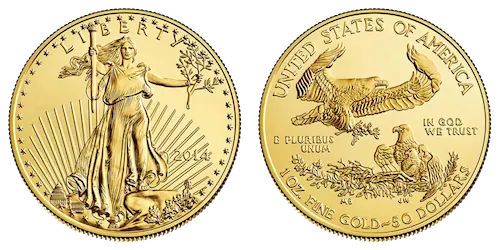
Canadian Gold Maple Leaf: 24-karat (99.99% pure) gold with advanced anti-counterfeiting features. Maples typically carry 3-6% premiums and are highly liquid internationally. The higher purity appeals to some investors, though the softer metal scratches more easily than 22-karat Eagles.
South African Krugerrand: The original modern gold bullion coin (introduced 1967), containing one ounce of gold in 22-karat alloy. Krugerrands often trade with the lowest premiums (2-4% over spot) due to large global supply, making them efficient for strictly metal exposure.
Other notable bullion coins include Austrian Philharmonics, British Britannias, Chinese Pandas, and Australian Kangaroos. Each has loyal followings and sufficient liquidity for investment purposes.
Bullion Pricing: Premiums and Spreads
Understanding premium structures is essential for calculating true returns. When you buy bullion, you pay the spot price of gold plus a premium covering fabrication, distribution, and dealer profit. When you sell, dealers typically pay below spot (the "bid" price) while selling above spot (the "ask" price). This spread represents dealer profit and your transaction cost.
For example, if gold spot price is $2,000/oz:
- You might buy an American Eagle for $2,140 (7% premium)
- The dealer might buy it back for $1,980 (1% below spot)
- Your round-trip transaction cost is $160 per ounce (8%)
This means gold must appreciate 8% just to break even on immediate resale. Longer holding periods dilute this impact, but transaction costs matter significantly for short-term trades.
Premiums fluctuate based on supply and demand. During the March 2020 COVID panic, bullion premiums spiked to 15-20% as refineries shut down and demand surged. During calm markets, premiums compress. Monitoring premiums relative to historical averages helps identify favorable buying opportunities.
Advantages of Gold Bullion Investment
Simple valuation: A one-ounce gold coin contains one ounce of gold worth the spot price plus a small premium. No specialized knowledge required—any investor can check gold prices and understand their holdings' value within seconds.
High liquidity: Bullion coins and bars from major mints sell quickly at any precious metals dealer, pawn shop accepting gold, or online platform. You can convert to cash within hours or days in most cases. This liquidity provides flexibility and peace of mind.
Lower entry premiums: Bullion typically costs only 3-8% above gold content value. Rare coins often carry 20-100%+ premiums over gold content, meaning you need significantly more appreciation just to break even.
Predictable pricing: Bullion prices correlate tightly with gold spot prices. When gold rises 10%, your bullion appreciates approximately 10% (premium fluctuations cause minor deviations). This predictability simplifies portfolio calculations and expectations.
Divisibility: Fractional coins (1/10 oz, 1/4 oz, 1/2 oz) allow selling portions of holdings without liquidating entire positions. This flexibility helps with gradual profit-taking or meeting specific dollar amount needs.
No expertise required: Anyone can buy bullion successfully. No grading knowledge, market timing, or numismatic expertise necessary. This accessibility makes bullion ideal for investors wanting gold exposure without becoming coin experts.
Lower storage costs: Modern bullion is compact and standardized. A million dollars in gold occupies roughly the space of a shoebox, far less than rare coins with protective holders and documentation.
Learn more about acquiring bullion: Gold Bullion Investment Guide
Disadvantages of Gold Bullion Investment
Limited appreciation potential: Bullion tracks gold prices—period. If gold stays flat for a decade, your bullion stays flat. There's no numismatic premium to develop, no rarity appreciation, no collector demand boost. Your upside is capped at gold's performance.
No collectible premium: A 2024 American Eagle will never be rare. Millions exist, and mints continue producing them. Unlike rare coins where supply is fixed and some pieces become highly sought after, modern bullion lacks scarcity value beyond metal content.
Dealer spreads reduce returns: The bid-ask spread (difference between buying and selling prices) typically runs 5-10% for bullion. Frequent trading amplifies these costs. Buy-and-hold investors face this cost once, but it's still a friction traditional investments like stocks don't have.
Counterfeiting concerns: Fake gold bars and coins exist, particularly tungsten-filled counterfeits that pass basic weight and dimension tests. While sophisticated testing equipment can detect fakes, individual investors may lack access. Buying from reputable dealers and sticking to government-issued coins reduces this risk but doesn't eliminate it entirely.
Storage and insurance costs: Physical metal requires secure storage—home safes, bank safe deposit boxes, or professional vault storage. Insurance adds ongoing costs. These expenses reduce net returns over time.
No income generation: Gold pays no dividends or interest. Your return depends entirely on price appreciation. During periods when gold stagnates, opportunity cost compared to income-generating assets accumulates.
Understanding Rare and Historic Gold Coins: Numismatic Investment
Rare coins occupy the intersection of precious metals and collectibles. Their value derives from gold content plus numismatic factors: rarity, historical significance, condition, and collector demand. A rare gold coin might contain $1,500 of gold but trade for $15,000 based on these additional factors.
What Makes Coins "Rare"?
Rarity isn't absolute—it's relative to demand. A coin with 500 known examples might be common in an obscure series nobody collects, while a coin with 5,000 examples could be rare in a highly popular series. Several factors create numismatic value:
Low mintage: Coins produced in small quantities offer inherent scarcity. The 1861 Paquet Reverse Double Eagle had a mintage of about 19,000, but only two examples are known to exist today. Even coins with slightly higher survival rates become valuable when demand exceeds supply.
Historical significance: Coins from important periods, representing transitions, or connected to major events command premiums. The 1933 Double Eagle is famous for being forbidden from circulation and nearly all examples destroyed by government order.
Condition rarity: Many coins are common in low grades but extremely rare in pristine condition. A Morgan Dollar might be worth $30 in typical circulated condition but $5,000 in gem uncirculated state. The finest-known examples of any coin type typically command enormous premiums.
Variety and errors: Coins with minting errors, die varieties, or unusual characteristics attract specialist collectors. A 1955 Doubled Die Lincoln Cent or 1942/1 Mercury Dime trades for multiples of what common dates bring.
Surviving population: Age alone doesn't create rarity—many ancient coins are relatively affordable because large hoards were discovered. Survival rates matter more than age. A 100-year-old coin with a million examples surviving is less rare than a 30-year-old coin with 100 examples.
Professional Grading and Authentication
The rare coin market relies heavily on third-party grading services that authenticate coins and assign numerical grades. The two dominant services—PCGS (Professional Coin Grading Service) and NGC (Numismatic Guaranty Corporation)—encapsulate coins in sealed holders (called "slabs") with labels showing grade and certification number.
Grading uses the 70-point Sheldon scale, from Poor-1 to Perfect-70 (written as MS-70 for uncirculated coins or PR-70 for proofs). Most circulated coins fall between Good-4 and Extremely Fine-45. Uncirculated coins range from MS-60 to MS-70.
Here's why grading matters: A 1907 St. Gaudens Double Eagle in MS-63 condition might sell for $2,500, while the same coin in MS-66 brings $8,000, and MS-67 fetches $25,000. Single grade-point differences dramatically impact value, especially at higher grades where populations thin rapidly.
Professional grading provides standardization, reduces counterfeiting risk, and creates liquid markets. PCGS and NGC populations (published data showing how many coins they've graded in each grade level) inform rarity assessments. Serious rare coin investing requires understanding grading and buying primarily certified coins.
Example: 1907 St. Gaudens Double Eagle
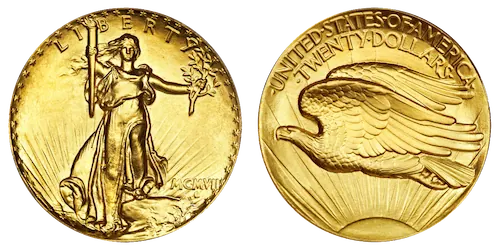
The 1907 St. Gaudens Double Eagle represents an ideal case study in numismatic value. This coin contains 0.9675 troy ounces of gold (worth roughly $1,900 at $2,000/oz gold). However, depending on variety and condition, these coins trade from $2,200 to over $3 million.
The common date 1907 No Motto in MS-63 grade sells for approximately $2,200-2,400—a modest 15-20% premium over gold content. Move to MS-65 and prices jump to $3,500-4,000. The finest MS-69 examples bring $150,000+. The ultra-rare 1907 Ultra High Relief pattern in gem condition sold for over $3 million.
This price range demonstrates how condition and rarity multiply value far beyond metal content. The investor buying a $2,200 common date primarily owns gold with modest numismatic premium. The collector spending $150,000 owns a genuinely rare object with minimal correlation to gold prices—even if gold dropped 50%, the MS-69 coin wouldn't lose half its value because collectors seek it regardless of gold prices.
Advantages of Rare Gold Coin Investment
Appreciation beyond gold prices: Rare coins can surge in value even when gold stays flat. A coin appreciating from $5,000 to $10,000 while gold remains unchanged represents 100% profit unrelated to metal prices. This provides diversification within precious metals themselves.
Fixed supply: Unlike bullion where mints produce new coins indefinitely, rare coin populations are fixed (aside from occasional hoard discoveries). As collectors compete for finite pieces, prices can rise substantially. The 1909-S VDB Lincoln Cent will never have more than its original mintage—supply is permanently capped.
Lower correlation to gold: During gold bear markets, quality rare coins often maintain value better than bullion. Collectors continue seeking key dates regardless of metal prices. This provides genuine diversification—your rare coins might appreciate while your bullion declines.
Passion and enjoyment: Collecting offers intellectual stimulation and aesthetic pleasure beyond pure investment. Learning numismatic history, studying die varieties, and building sets provides satisfaction that bullion stacking cannot. For many, this enjoyment justifies lower liquidity or higher costs.
Potential for extraordinary gains: Identifying undervalued coins before broader market recognition can produce 10x-100x returns. A coin purchased for $500 that becomes recognized as genuinely rare could eventually sell for $50,000. These home runs rarely occur with bullion.
Historical preservation: Rare coin collectors preserve monetary history. Owning a gold coin from 1850s California or an ancient Roman aureus connects you to the past in tangible ways. This cultural value transcends financial metrics.
Privacy considerations: Rare coin transactions often involve private sales between collectors or through auction houses rather than reportable bullion dealer transactions. This can provide privacy advantages, though tax obligations remain regardless of transaction method.
Explore rare coin investing: Rare Coin Investment Strategies
Disadvantages of Rare Gold Coin Investment
High premiums over melt value: Paying $5,000 for a coin containing $1,500 of gold means you need 233% appreciation just to break even if numismatic premium disappears. If gold rises 10% to $1,650, your coin needs to appreciate to $5,500 just to maintain the same premium ratio. Downside risk extends below gold value if premiums collapse.
Expertise requirement: Successfully investing in rare coins demands substantial knowledge. Understanding grading, recognizing counterfeits, knowing market values, and identifying opportunities requires years of study. Beginners frequently overpay for overgraded or common coins marketed as rare.
Limited liquidity: Selling rare coins takes longer than bullion. You need to find collectors or dealers interested in your specific coins, which may take weeks or months. During urgent situations requiring quick cash, you'll likely accept significant discounts.
Market size and depth: The rare coin market is tiny compared to bullion or stocks. Trading volumes are low, and price discovery can be opaque. Auction results and private sales don't always reflect true market values. This illiquidity creates both opportunities and risks.
Condition sensitivity: A coin's grade dramatically affects value, but grading has subjective elements. The difference between MS-64 and MS-65 can double prices, yet experts sometimes disagree on grades. Buying a coin as MS-65 that later downgrades to MS-64 causes immediate loss.
Counterfeit epidemic: High-value rare coins attract sophisticated counterfeiters. Chinese operations produce fake slabs that replicate PCGS/NGC holders. Even certified coins from decades ago before modern anti-counterfeiting features sometimes turn out fake upon resubmission. Verification requires expertise or professional services.
Storage complexity: Rare coins require more space than bullion due to protective holders and documentation. Maintaining original packaging, certificates, and provenance records becomes important. Environmental control matters—humidity and temperature fluctuations can damage coins.
Market cycles and sentiment: Numismatic markets experience boom-bust cycles unrelated to gold prices. The late 1980s saw spectacular rare coin price increases followed by 50-70% crashes in the early 1990s. Timing matters enormously—buying at market peaks leads to years or decades of losses.
Transaction costs: Auction houses charge buyer's premiums (15-20%) and seller's commissions (10-15%). Private dealer transactions involve significant bid-ask spreads (often 20-30%). These costs exceed bullion transaction costs substantially.
Head-to-Head Comparison: Key Decision Factors
Understanding advantages and disadvantages of each option helps, but direct comparison across critical dimensions clarifies which suits your situation.
Liquidity: How Quickly Can You Sell?
Winner: Bullion
Bullion sells nearly instantly. Walk into any precious metals dealer or pawn shop, and they'll make offers within minutes. Online platforms like APMEX provide instant quotes and pay within days of receiving metal. This liquidity provides security and flexibility.
Rare coins require finding appropriate buyers. Common dates sell relatively quickly to dealers, but at steep discounts to retail prices. Truly rare pieces require auction consignment (3-6 months) or finding specialist collectors. Emergency sales mean accepting 30-50% discounts.
Appreciation Potential: Which Gains More Value?
Winner: Rare Coins (but with caveats)
The best-performing rare coins dramatically outpace bullion over decades. A choice MS-65 Morgan Dollar purchased in 1980 for $500 now sells for $8,000+ while gold increased roughly 5x over the same period. Rare coins can 10x, 20x, or 100x with the right pieces and timing.
However, average rare coins barely outpace bullion, and many underperform. The key is selecting genuinely scarce pieces in strong markets. Without expertise, you'll likely buy mediocre coins that appreciate slowly if at all. Bullion guarantees you track gold prices—nothing more, nothing less.
Downside Protection: Which Preserves Value in Bear Markets?
Winner: Bullion
Bullion can't fall below gold's intrinsic value (minus small premiums). If gold crashes 50%, you lose 50%—painful but predictable. Rare coins can lose both metal value and numismatic premium simultaneously. A coin worth $5,000 could drop to $2,000 if gold falls and collectors lose interest.
During the 2008 financial crisis, gold fell roughly 25% from peak to trough. Quality rare coins held better, but mid-tier common dates fell 40-50% as collectors liquidated. Bullion's floor provides comfort during panics.
Knowledge Requirement: Which Needs More Expertise?
Winner: Bullion
Bullion requires zero specialized knowledge. If you can use a calculator and check gold prices, you can invest successfully. Rare coins demand years of study: grading, authentication, market dynamics, population reports, auction results, and historical context. Most beginners lose money on rare coins through overpaying and poor selections.
Transaction Costs: Which Is Cheaper to Trade?
Winner: Bullion
Bullion round-trip costs typically run 5-10%. Rare coins face 20-35% transaction costs between dealer spreads or auction fees. If you're trading frequently or holding short-term, these costs devastate returns. Long-term holders amortize costs, but bullion still wins on transaction efficiency.
Portfolio Diversification: Which Adds More Value?
Winner: Rare Coins
Bullion correlates strongly with gold prices, which often move with inflation expectations and real interest rates. Rare coins correlate less with macroeconomic factors and more with collector market dynamics, wealth concentration among high-net-worth individuals, and numismatic trends. This lower correlation provides genuine diversification even within a precious metals allocation.
Storage and Maintenance: Which Is Easier?
Winner: Bullion
Bullion stacks efficiently and requires minimal maintenance beyond secure storage. Rare coins need protective holders, environmental control, documentation, and more space per dollar value. Bullion's simplicity suits investors wanting exposure without complications.
Tax Treatment: Any Differences?
Tie: Both Treated as Collectibles
The IRS classifies both bullion and rare coins as collectibles subject to maximum 28% long-term capital gains rate rather than preferential 15-20% rate for stocks. Short-term gains (held less than one year) are taxed as ordinary income for both. Neither offers tax advantages—both face relatively unfavorable treatment compared to paper investments.
Hybrid Strategies: Combining Both Approaches
Most sophisticated precious metals investors don't choose exclusively between bullion and rare coins—they combine both strategically.
The 80/20 Strategy
Allocate 80% to bullion for liquid metal exposure and 20% to select rare coins for numismatic upside. The bullion core provides security, liquidity, and gold price tracking. The rare coin allocation offers appreciation potential beyond metal prices without excessive risk concentration.
Within the 20% rare coin allocation, focus on certified coins (PCGS/NGC) in strong series with active collector markets: Morgan Dollars, Saint-Gaudens Double Eagles, Indian Head gold, or key-date Lincoln Cents. Avoid obscure series, uncertified coins, or pieces requiring specialized expertise.
The Core-Satellite Approach
Use bullion as your core gold holding (70-90% of precious metals allocation) and add "satellite" positions in rare coins that meet specific criteria:
- You genuinely enjoy the coins and would be happy owning them even if they don't appreciate
- You've researched the series extensively and understand value drivers
- You're buying at reasonable premiums (under 50% over gold content for common dates)
- The coins are certified by PCGS or NGC
- You're prepared to hold 5+ years
This approach prioritizes bullion's certainty while allowing numismatic participation when compelling opportunities arise.
The Collector-Investor Model
Some individuals are passionate collectors first, investors second. If you truly enjoy numismatics, building a rare coin collection focused on themes you love (type coins, a specific series, a historical period) can provide both pleasure and investment returns.
In this model, allocate to rare coins based on collecting passion but maintain discipline:
- Set a budget (perhaps 25-40% of precious metals allocation)
- Buy quality over quantity—better to own 10 choice pieces than 100 mediocre ones
- Focus on one or two series until you develop genuine expertise
- Join numismatic organizations and attend shows to deepen knowledge
- Keep some bullion for liquidity and simplicity
The Opportunistic Strategy
Primarily hold bullion but watch for rare coin opportunities during market weaknesses. When economic conditions pressure collectors to sell, premiums compress and bargains emerge. An investor who normally buys bullion might purchase rare coins at 10-20% premiums during market panics, then flip them during strong markets when premiums expand.
This strategy requires capital patience, market monitoring, and numismatic knowledge but can generate returns beyond simple bullion holding. The key is maintaining discipline—only buying genuinely undervalued pieces rather than getting swept up in collecting for its own sake.
Decision Framework: Which Should You Choose?
Your optimal approach depends on several personal factors. Use this framework to determine what makes sense for your situation.
Choose Gold Bullion If:
- You want straightforward gold price exposure without complications
- You prioritize liquidity and ability to sell quickly
- You're new to precious metals investing
- You plan to allocate significant capital (over $50,000+) and want efficient deployment
- You value simplicity and low maintenance
- You view gold as portfolio insurance rather than primary investment
- You don't have time or interest to develop numismatic expertise
- You might need to liquidate on short notice
- You're uncomfortable with the subjectivity of collectibles markets
Choose Rare Coins If:
- You're genuinely interested in numismatics and enjoy collecting
- You're willing to invest years developing expertise
- You have long time horizons (5-10+ years minimum)
- You seek appreciation potential beyond gold prices
- You enjoy researching, attending shows, and engaging with collector community
- You're comfortable with illiquidity and long holding periods
- You want genuine diversification within precious metals
- You can afford to allocate smaller amounts ($10,000-50,000 range) to build meaningful positions
- You're prepared to accept higher transaction costs
Choose a Hybrid Approach If:
- You want gold exposure but also enjoy numismatic aspects
- You have sufficient capital to diversify across both categories
- You're willing to develop selective rare coin knowledge
- You appreciate benefits of both liquidity (bullion) and upside potential (rare coins)
- You're building a long-term precious metals position
Practical Implementation: How to Get Started
Starting with Gold Bullion
Step 1: Choose reputable dealers. Stick with established names like APMEX, SD Bullion, JM Bullion, or local shops with strong reputations. Check Better Business Bureau ratings and online reviews.
Step 2: Compare premiums. Shop multiple dealers for identical products. Premiums vary significantly—a few minutes of comparison can save hundreds.
Step 3: Start with government-issued coins. American Eagles, Canadian Maple Leafs, or Krugerrands provide maximum liquidity and recognition. Bars are fine once you're comfortable, but coins offer flexibility.
Step 4: Buy in standard sizes. One-ounce coins are most liquid. Fractional coins (1/10 oz, 1/4 oz) carry higher premiums but allow partial position sales. Very large bars (10 oz+) have lower premiums but limited buyer pools.
Step 5: Arrange secure storage immediately. Don't let gold sit unsecured "temporarily." Install a quality safe, rent a safe deposit box, or use professional vault storage from day one.
Detailed buying guide: Physical Gold Investing
Starting with Rare Coins
Step 1: Education before buying. Spend 3-6 months reading, joining ANA (American Numismatic Association), attending local coin club meetings, and learning grading basics. This investment prevents costly mistakes.
Step 2: Focus on one series initially. Choose a specific collecting area—Morgan Dollars, Walking Liberty Half Dollars, Indian Head gold—and become an expert rather than dabbling across many series.
Step 3: Buy only certified coins initially. Stick with PCGS and NGC graded coins until you develop authentication and grading skills. The slab premium is insurance against mistakes.
Step 4: Start with mid-grade examples. Don't buy gem-grade rarities or heavily circulated commons. Mid-grade certified coins (MS-63 to MS-65, or AU-55 to MS-62 for older coins) offer best value proposition for learning.
Step 5: Use price guides but verify with realized prices. The Grey Sheet, PCGS Price Guide, and NGC Price Guide provide baselines, but check recent auction results and dealer asking prices to understand real markets.
Step 6: Establish relationships with reputable dealers. Find dealers who educate rather than pressure sell. Good dealers will explain grading, help you understand premiums, and might buy coins back when you're ready to sell.
Step 7: Attend major coin shows. The ANA World's Fair of Money, FUN show, or regional shows provide opportunities to handle coins, meet dealers, and learn from seminars.
Comprehensive rare coin strategies: Rare Coin Investment Guide
Common Mistakes to Avoid
Bullion Mistakes
Overpaying on premiums: Buying bullion at 15-20% over spot during supply crunches locks in high costs. Unless urgently needed, wait for premiums to normalize.
Neglecting security: Leaving gold in dresser drawers or obvious locations invites theft. Proper storage isn't optional.
Buying collectible bullion: Modern commemoratives, colorized coins, or "collectible" bullion trade at huge premiums over standard bullion. These premiums rarely hold when reselling. Stick to plain bullion unless collecting for enjoyment.
Panic selling: Liquidating during gold price drops locks in losses. Bullion is long-term insurance, not short-term speculation.
Rare Coin Mistakes
Buying before learning: Novices frequently overpay by 50-100% for coins that experienced collectors wouldn't touch. Education prevents expensive lessons.
Trusting raw coin grades: Sellers claiming "This VF-30 coin is really EF-40 quality!" are almost always wrong or dishonest. Buy certified coins or accept you're buying common-grade pieces.
Focusing on absolute rarity over collectible rarity: A coin with 500 surviving examples in an unpopular series might appreciate slowly, while a coin with 5,000 examples in a hot series surges. Collector demand matters more than absolute scarcity.
Chasing grades: Buying MS-69 examples hoping for MS-70 upgrades is speculation, not investing. Buy coins you're happy owning at current grades.
Ignoring markets cycles: Buying rare coins at market peaks (when enthusiast magazines fill with ads and prices seem to only go up) leads to years of losses. The best buying comes during economic downturns when collectors are forced sellers.
Universal Mistakes
Overallocating to gold: Whether bullion or rare coins, gold should be a portfolio component, not the entire portfolio. Maintain diversification with productive assets.
Neglecting insurance: Homeowners insurance typically caps precious metals coverage at $1,000-2,000. Additional coverage is essential for significant holdings.
Poor record-keeping: Track purchase prices, dates, and documentation for tax purposes. You'll need cost basis when selling.
Exit Strategies: Planning How to Sell
Understanding how to sell is as important as knowing how to buy.
Selling Bullion
Bullion offers multiple selling options:
Local dealers: Immediate payment but typically 1-3% below spot. Convenient for small quantities needing quick cash.
Online dealers: Companies like APMEX, Kitco, or SD Bullion buy bullion by mail. Prices are typically better than local shops (often spot or slightly above for popular coins), but you ship first and wait for payment.
Private party sales: Selling directly to other investors through forums or local meetups can capture retail prices, but requires caution against scams and counterfeits. Only practical for smaller transactions.
Timing bullion sales depends on your needs and gold's position. If you're rebalancing a portfolio, selling portions when gold spikes makes sense. If you need cash urgently, you'll sell regardless of price.
Selling Rare Coins
Rare coins require more strategic selling:
Major auction houses: Heritage, Stack's Bowers, Legend, or Great Collections provide access to serious collectors and competitive bidding. Ideal for coins worth $1,000+. Expect 15-20% buyer's premium (which adds to your selling price) and 10% seller's commission (which reduces your net). Turnaround is 3-6 months from consignment to payment.
Dealer direct purchase: Wholesale prices (typically 60-80% of retail) but immediate payment. Best for common dates or when you need cash quickly.
Private treaty sales: Some dealers facilitate private sales to their customer bases for higher-value pieces, typically at better prices than outright purchases.
Online marketplaces: eBay or specialized numismatic platforms allow direct sales to collectors. You capture retail prices but handle shipping, insurance, and customer service.
Timing rare coin sales matters enormously. Selling during strong bull markets when premiums expand maximizes returns. Selling during recessions when collectors are scarce means accepting steep discounts.
Conclusion: Making the Right Choice for Your Situation
The bullion versus rare coins decision isn't binary—both can serve portfolio purposes, and many investors own both. Understanding their distinct characteristics helps you deploy each strategically.
Gold bullion provides straightforward precious metals exposure, high liquidity, and gold price tracking without complications. It's ideal for investors seeking portfolio insurance, inflation hedging, or simple gold exposure without developing specialized expertise.
Rare coins offer appreciation potential beyond gold prices, lower correlation to metal markets, and collectible satisfaction—but require knowledge, patience, and comfort with illiquidity. They suit collectors-turned-investors and those willing to develop numismatic expertise.
For most investors, a bullion-heavy approach (70-90% of precious metals allocation) with selective rare coin positions makes sense. This captures gold exposure benefits while allowing numismatic participation when compelling opportunities arise.
Whatever you choose, prioritize security, buy from reputable sources, maintain realistic expectations, and remember that precious metals—whether bullion or rare coins—serve as portfolio components, not complete portfolios themselves. Used appropriately within diversified holdings, both bullion and rare coins can play valuable roles in long-term wealth preservation and growth.
Continue learning: